
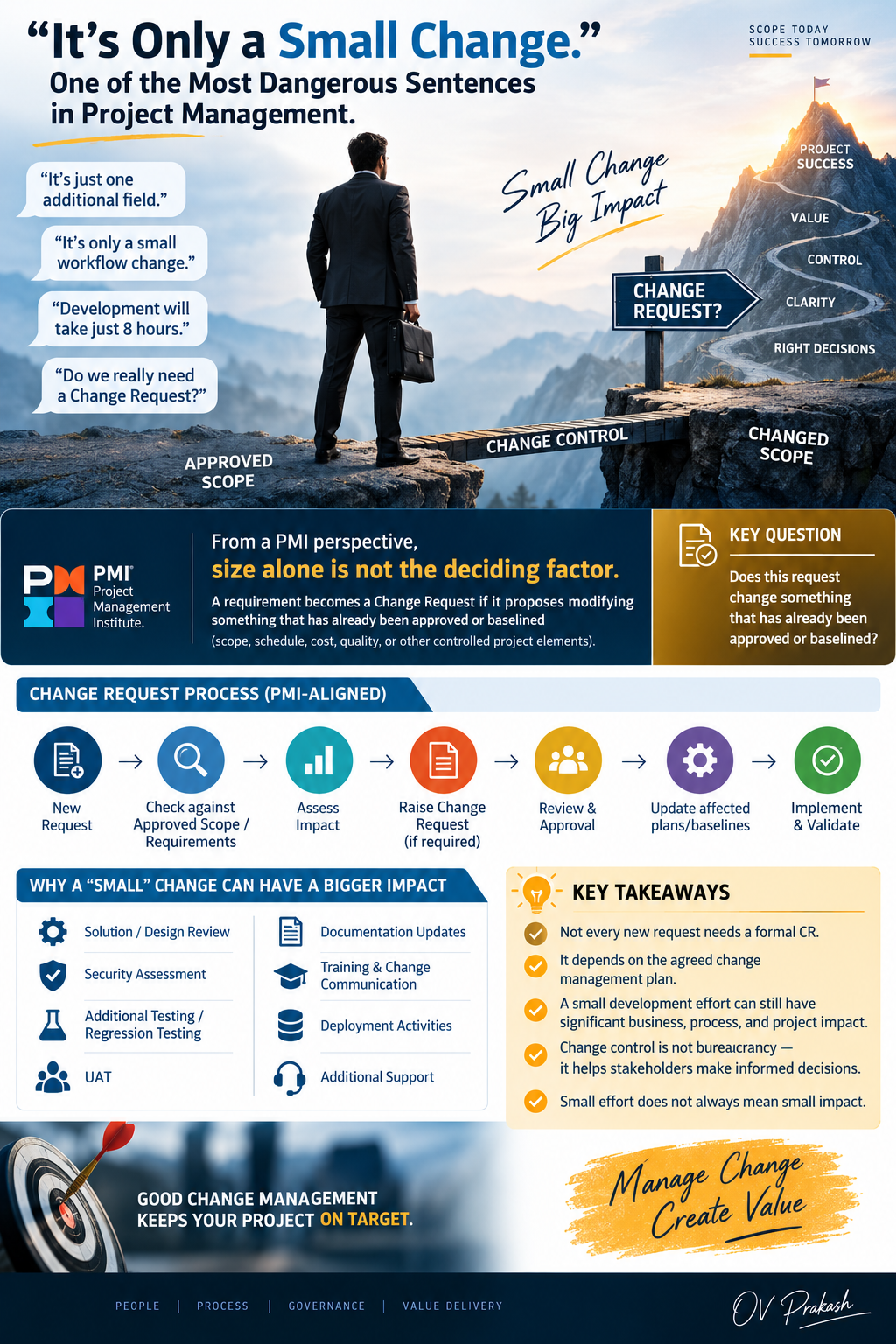
During an ERP implementation, we often hear: “It’s just one additional field.” “It’s only a small workflow change.” “Development will take just eight hours.” Or even, “Do we really need a Change Request?”
When does a small requirement become a Change Request?
From a PMI-aligned project management perspective, size alone is not the deciding factor. The first question should be whether the request changes something that has already been approved, baselined or otherwise placed under project control.
If the requirement is already within the approved scope, it may simply be clarification or execution of an existing requirement. If it proposes a change to approved scope or another controlled project element, it should be evaluated through the project’s agreed change-control process.
A practical change-control flow
Why a “small” ERP change can have a bigger impact
An eight-hour development change may still require much more than eight hours of project effort. The broader impact can include:
- Solution and design review
- Security assessment
- Additional or regression testing
- User Acceptance Testing (UAT)
- Documentation updates
- Training and change communication
- Deployment activities
- Additional support and hypercare
Change control is not bureaucracy
Good change management is not about making every request difficult. It is about ensuring stakeholders understand the full impact before making a decision.
Not every new request necessarily needs a formal Change Request. The agreed change-management approach should define how proposed changes are evaluated, who has authority to approve them, and how affected project information is updated.
What matters is that the project team does not judge a request only by coding effort. Scope, schedule, cost, quality, risk, testing, deployment, business readiness and downstream dependencies may all need consideration.
The takeaway
Small effort does not always mean small impact. Strong project governance creates visibility before commitment, so the project can make an informed decision rather than discover the consequences later.