For decades, organizations have asked one familiar question: “How much will we sell next month?”
Modern supply chains require a more powerful question: “What should we do now, based on what demand is likely to become?”
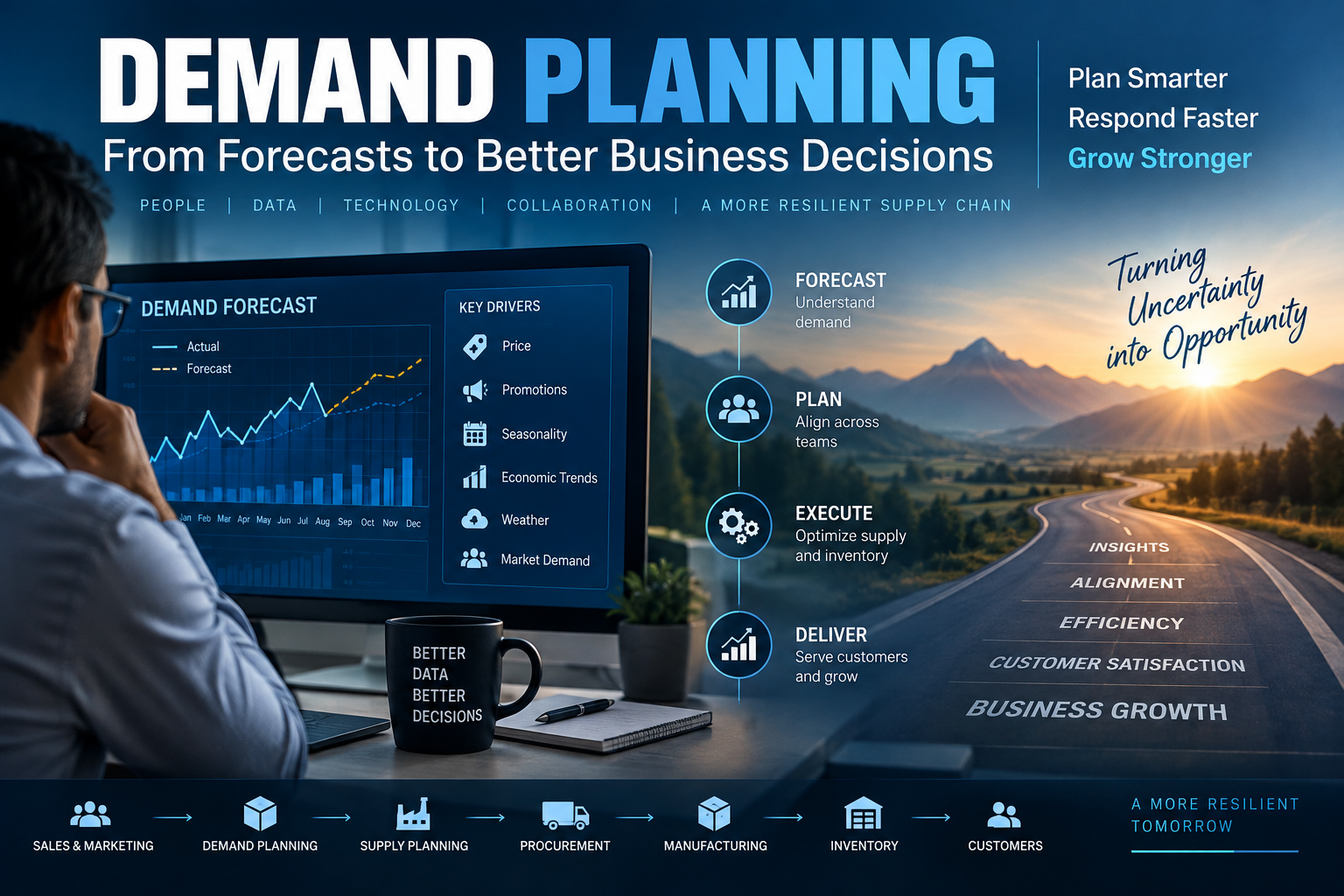
That distinction represents the evolution from traditional demand forecasting to intelligent demand planning. A forecast is a number. Demand planning is a business decision-making process connecting that number with inventory, procurement, production, capacity, finance, sales and customer commitments.
Demand Forecasting vs. Demand Planning
Demand Forecasting predicts future demand using historical information, statistical techniques, market intelligence and increasingly AI/ML.
Demand Planning takes the forecast further. It asks how much inventory to carry, what procurement should buy, what manufacturing should produce, where inventory should be positioned, whether capacity is sufficient and which assumptions Sales, Finance and Operations should agree on.
Major Demand Forecasting Techniques
1. Qualitative Forecasting
Useful when historical information is limited. Examples include sales-force estimates, expert opinion, market research, customer surveys, Delphi methods and management consensus. It is especially useful for new products and new markets, but human bias must be managed.
2. Naïve Forecasting
A simple baseline where the next-period forecast equals the current-period actual demand. If an expensive AI model cannot consistently outperform a naïve forecast, its complexity deserves scrutiny.
3. Moving Average
Moving averages calculate forecasts using several previous periods. They are simple, transparent and effective for relatively stable demand, although they can react slowly when demand changes rapidly.
4. Weighted Moving Average
Greater importance is assigned to recent demand, allowing the forecast to respond faster to changing patterns.
5. Exponential Smoothing
Exponential smoothing gives progressively greater importance to recent observations. More advanced variations can account for trend and seasonality.
6. Causal Forecasting
Demand can depend on price, promotions, inflation, weather, economic conditions, competitor activity, marketing and events. This changes forecasting from asking what happened previously to understanding what variables are driving demand.
AI & Machine Learning Change the Equation
Modern demand planning can combine historical information with multiple demand signals. AI/ML can help identify complex seasonality, anomalies, promotion effects, external correlations, changing customer behaviour and SKU/location-specific patterns.
Microsoft Dynamics 365 Demand Planning
For organizations running Microsoft Dynamics 365 Supply Chain Management, modern demand planning can bring together historical data, demand signals, forecast models, planner review, adjustments and collaboration, a consensus demand plan, and supply execution.
The objective is not simply another forecast spreadsheet. It is a repeatable and governed planning process.
From Single-Input Forecasting to Multiple Demand Signals
Instead of relying only on historical sales, organizations can think in terms of historical sales plus pricing, promotions, inflation, weather, market signals and business intelligence feeding an intelligent forecast.
Demand Planning Must Connect to Inventory
A forecast without an inventory strategy has limited value. The business must understand current inventory, open purchase orders, production capacity, safety stock, supplier lead time and customer service targets.
Manufacturing Impact
For manufacturers, demand planning influences master production scheduling, material requirements planning, capacity planning, raw-material procurement, supplier scheduling, warehouse capacity and labour planning.
A demand increase from 10,000 to 15,000 units is not merely a forecasting change. It can mean additional raw materials, machine hours, labour, warehouse capacity, transportation and working capital.
Demand Planning Is Also Financial Planning
Over-forecasting can create excess inventory, higher carrying costs, locked working capital, obsolescence and write-offs. Under-forecasting can cause stockouts, lost sales, emergency procurement, production disruption, expedited freight and customer dissatisfaction.
Forecast error therefore eventually becomes financial and operational error.
Measure More Than Forecast Accuracy
Organizations should monitor forecast accuracy, forecast bias, WAPE/MAPE, service level, inventory turns and working capital. A forecast can appear reasonably accurate overall while still containing systematic bias.
Demand Planning Should Feed S&OP
A mature cycle connects data collection, statistical or AI forecasting, demand review, consensus demand planning, supply review, financial review and executive S&OP.
The real power is having Sales, Supply Chain, Operations and Finance working from one agreed version of demand.
One of the Biggest Mistakes in Demand Planning
Many organizations start by asking which AI forecasting tool they should implement. A stronger sequence is:
Technology should strengthen the planning process, not compensate for a broken one.
ABC–XYZ Segmentation Makes Forecasting Smarter
Not every SKU deserves the same forecasting effort. ABC segmentation considers business value, while XYZ segmentation considers demand variability. An AX item—high value and predictable—and an AZ item—high value and unpredictable—should not necessarily use the same forecasting strategy.
The Future: From Forecasting to Demand Sensing
Traditional forecasting asks, “Based on history, what will happen?” Demand sensing increasingly asks, “Based on what is happening right now, has demand changed?” Signals can include customer orders, POS information, e-commerce transactions, inventory movements, promotions, weather, pricing and economic indicators.
My Key Takeaway
The future of demand planning isn't about finding one perfect algorithm. It is about combining Data + Statistical Models + AI + Human Intelligence + ERP Execution + Governance.
A forecast only becomes valuable when it changes a decision. The strongest organizations will not necessarily predict the future perfectly. They will detect change faster, evaluate its impact sooner and respond better than their competitors.
A Question for Supply Chain Leaders
Where is your organization today—Excel-based forecasting, statistical forecasting, collaborative S&OP, AI/ML forecasting, or demand sensing and continuous planning?
And more importantly: Is forecast accuracy still your main KPI—or are you measuring the business decisions that the forecast improves?